AIBench: Benchmarking 8 LLMs on Real-World Code Generation
We evaluated eight frontier and budget LLMs across 240 machine-verified React and Rust coding trials. Quality still costs money, but retries, latency, and routing strategy matter just as much.
Prefer the full version? Download the complete whitepaper (PDF, 13 pages). It includes the full methodology, per-task result tables, latency analysis, methodological notes, and deployment guidance.
Abstract
We evaluated eight large language models on 10 code generation tasks spanning two technology stacks: React (TypeScript, frontend) and Rust (systems programming). Each model ran three independent trials per task, for 30 trials per model and 240 trials total. Every submission was machine-verified by a test harness, with up to three retry attempts allowed after failure.
The headline result: Claude Fable 5 was the only model to achieve a perfect score, passing 30/30 trials at a total cost of $7.97. DeepSeek V4 Flash passed 24/30 trials for $0.053, creating a 152x total-cost spread for a six-trial quality gap. We also find that verification-driven retries are not optional infrastructure: across all eight models, first-attempt pass rate averaged 40%, while final pass rate within three attempts averaged 87%.
1. Methodology
1.1 Task suites
The benchmark consists of two suites of five tasks each, ordered by increasing difficulty (L1–L5):
| Level | React suite | Rust suite |
|---|---|---|
| L1 | Stat card component | Merge intervals algorithm |
| L2 | Login form with validation | Word-count CLI (wc clone) |
| L3 | Sortable users table | LRU cache implementation |
| L4 | Posts CRUD interface | Concurrent HTTP fetcher |
| L5 | Multi-page application | SPSC lock-free ring buffer |
The React suite tests component composition, state management, and form handling. The Rust suite escalates from basic algorithms to ownership-heavy concurrent code, where the L5 lock-free ring buffer requires correct use of atomics and memory ordering.
1.2 Evaluation protocol
- Verification: every task is graded by an automated harness (compilation, unit tests, and behavioral checks). No human judgment is involved in pass/fail decisions.
- Trials: 3 trials per task, with up to 3 retry attempts per trial. On retry, the model receives the failure output and may revise its solution.
- Cost accounting: total API cost includes all retry attempts. Failed attempts count toward cost.
- Latency accounting: throughput probes and per-attempt wall-clock generation times were captured for every model.
- Date: all runs executed June 12-13, 2026.
1.3 Models under test
Eight models were evaluated under the same retry policy: Claude Fable 5, Claude Opus 4.8, Claude Opus 4.5, Claude Sonnet 4.6, DeepSeek V4 Pro, Qwen 3.7 Plus, DeepSeek V4 Flash, and GPT-5.4-mini.
2. Results
2.1 Overall pass rates
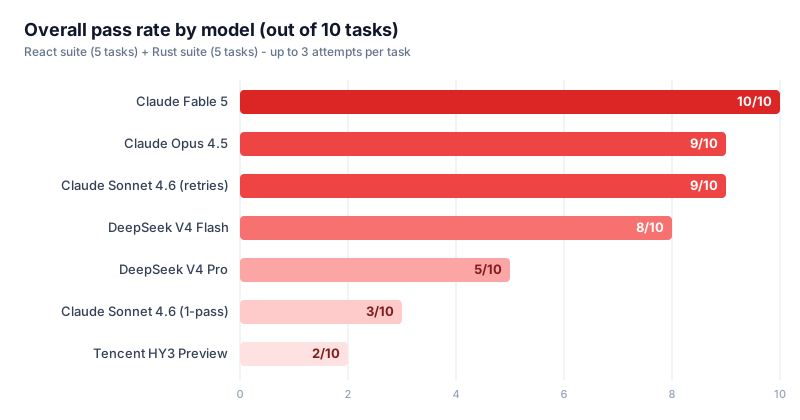
| Model | React | Rust | Total | Pass rate | Total cost |
|---|---|---|---|---|---|
| Claude Fable 5 | 15/15 | 15/15 | 30/30 | 100% | $7.97 |
| Claude Opus 4.8 | 13/15 | 15/15 | 28/30 | 93% | $2.80 |
| Claude Sonnet 4.6 | 12/15 | 15/15 | 27/30 | 90% | $2.05 |
| Claude Opus 4.5 | 12/15 | 14/15 | 26/30 | 87% | $3.19 |
| DeepSeek V4 Pro | 13/15 | 13/15 | 26/30 | 87% | $0.60 |
| Qwen 3.7 Plus | 10/15 | 15/15 | 25/30 | 83% | $0.59 |
| DeepSeek V4 Flash | 12/15 | 12/15 | 24/30 | 80% | $0.053 |
| GPT-5.4-mini | 12/15 | 11/15 | 23/30 | 77% | $0.33 |
Three observations stand out:
- Fable 5 is the reliability ceiling. It was the only model to clear all 30 trials.
- Opus 4.8 is the premium value upgrade. It outperformed Opus 4.5 while costing less.
- Budget models are close enough to matter. DeepSeek V4 Pro matched Opus 4.5's 87% pass rate at roughly one-fifth the cost.
2.2 Cost efficiency
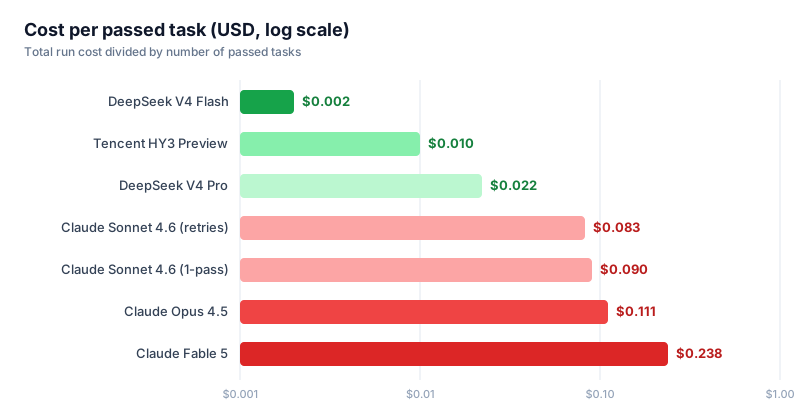
| Model | Passes | Total cost | Cost per pass |
|---|---|---|---|
| DeepSeek V4 Flash | 24 | $0.053 | $0.0022 |
| GPT-5.4-mini | 23 | $0.33 | $0.014 |
| DeepSeek V4 Pro | 26 | $0.60 | $0.023 |
| Qwen 3.7 Plus | 25 | $0.59 | $0.024 |
| Claude Sonnet 4.6 | 27 | $2.05 | $0.076 |
| Claude Opus 4.8 | 28 | $2.80 | $0.100 |
| Claude Opus 4.5 | 26 | $3.19 | $0.123 |
| Claude Fable 5 | 30 | $7.97 | $0.266 |
DeepSeek V4 Flash delivers a passed trial for $0.0022, about 121x cheaper per pass than Fable 5. That does not make it the best model; it makes it a serious first-line candidate for high-volume workflows where failed trials can be escalated to a stronger model.
The more interesting budget result is DeepSeek V4 Pro: it passed 26/30, tied with Opus 4.5, for $0.60 total. Quality tiers still exist, but the economic gap is wider than the capability gap.
2.3 The retry effect
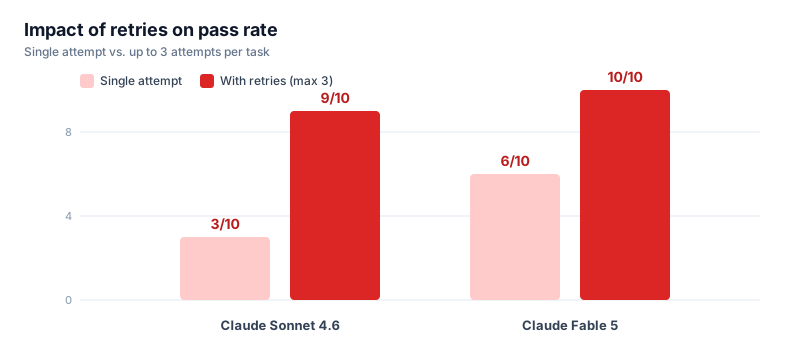
| Model | First attempt | Within 3 attempts | Improvement |
|---|---|---|---|
| Qwen 3.7 Plus | 8/30 | 25/30 | +17 |
| Claude Sonnet 4.6 | 11/30 | 27/30 | +16 |
| DeepSeek V4 Flash | 8/30 | 24/30 | +16 |
| Claude Fable 5 | 16/30 | 30/30 | +14 |
| Claude Opus 4.5 | 12/30 | 26/30 | +14 |
| DeepSeek V4 Pro | 12/30 | 26/30 | +14 |
| Claude Opus 4.8 | 16/30 | 28/30 | +12 |
| GPT-5.4-mini | 14/30 | 23/30 | +9 |
This is the most consequential finding of the run. Across all eight models, first-attempt pass rate averaged 40%; final pass rate within three attempts averaged 87%. Even Fable 5, the perfect scorer, passed only 16/30 trials on the first attempt.
The practical implication: a benchmark score without a retry policy attached is close to meaningless. Production agent loops should treat verification-plus-retry as baseline architecture, not an optimization.
2.4 Latency and throughput
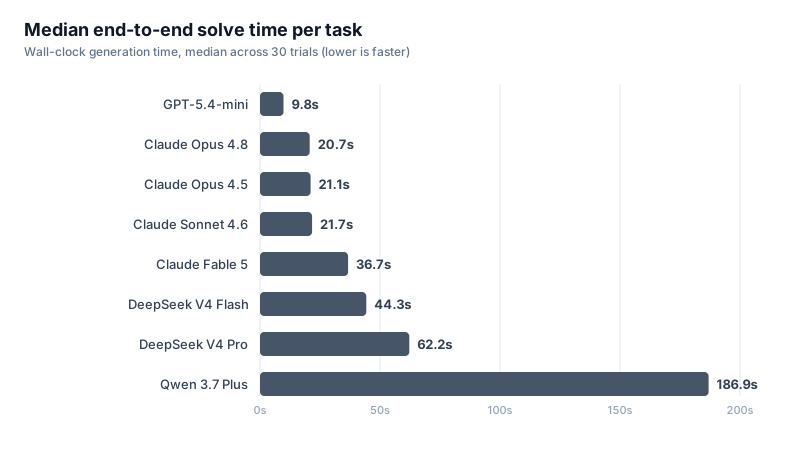
| Model | TTFT short | TTFT 16k | Output tok/s | Median solve |
|---|---|---|---|---|
| GPT-5.4-mini | 0.75s | 0.73s | 123 | 9.8s |
| Claude Opus 4.8 | 1.17s | 1.64s | 72 | 20.7s |
| Claude Opus 4.5 | 1.61s | 2.37s | 45 | 21.1s |
| Claude Sonnet 4.6 | 1.47s | 3.00s | 45 | 21.7s |
| Claude Fable 5 | 3.81s | 4.35s | 80 | 36.7s |
| DeepSeek V4 Flash | 2.58s | 2.17s | 103 | 44.3s |
| DeepSeek V4 Pro | 1.55s | -- | 82 | 62.2s |
| Qwen 3.7 Plus | 4.52s | 3.70s | 593* | 186.9s |
Latency is its own axis. GPT-5.4-mini is the fastest model in the study by a wide margin, despite landing last on pass rate. Qwen 3.7 Plus is inexpensive and excellent on Rust, but its median solve time was over three minutes. Interactive assistants and background batch pipelines should not optimize for the same model.
Qwen's headline output-throughput number appears inflated by provider-side batched streaming; the median solve time is the more useful operational metric.
3. Recommendations
Based on this run, our guidance for production code generation workloads:
- Maximum reliability: Claude Fable 5. It is the only model to clear all 30 trials.
- Best premium value: Claude Opus 4.8. It reached 93% while beating Opus 4.5 on both quality and price.
- Best balance: Claude Sonnet 4.6. It reached 90% at the lowest premium-tier cost.
- Cost-conscious production: DeepSeek V4 Pro. It matched Opus 4.5's pass rate at about one-fifth the cost.
- High-volume first line: DeepSeek V4 Flash. It passed 80% of trials for roughly five cents total.
- Interactive assistants: GPT-5.4-mini. It is the only model here with a sub-10-second median solve time.
- Rust-heavy workloads: Qwen 3.7 Plus. It went 15/15 on Rust at budget-tier pricing, if latency is acceptable.
- Always enable retries. The measured retry effect, 40% to 87% average pass rate, is larger than any model-tier upgrade in this run.
4. Methodological notes
This run resolves the biggest gaps from the earlier pilot: it uses three trials per task, captures cost telemetry across the full field, applies one retry policy to every model, and adds latency data.
The remaining caveats are narrower. Tasks come from our own production work, so they may not represent every engineering domain. Provider prices and routing change frequently. And even at temperature 0, provider-side non-determinism means rankings separated by one or two trials should be treated as directional, not permanent.
The AIBench harness and task suites are developed internally at AtomicoLabs. For the full analysis, download the whitepaper (PDF). Questions about methodology or requests for specific model evaluations: c@atomicolabs.com.